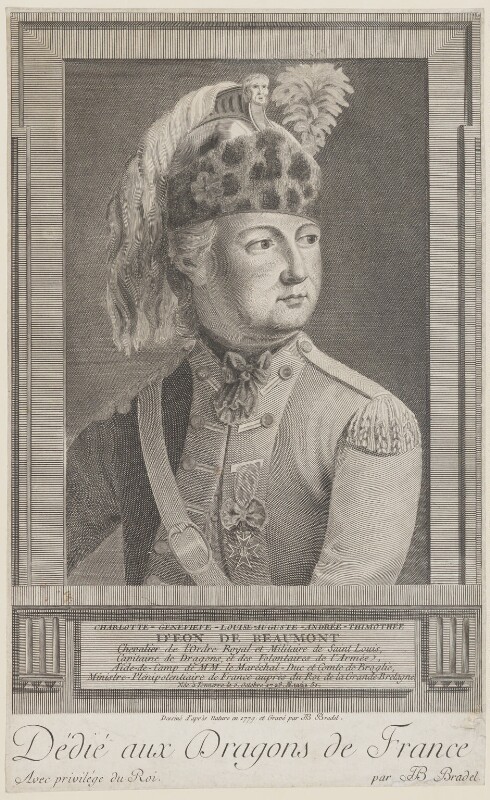
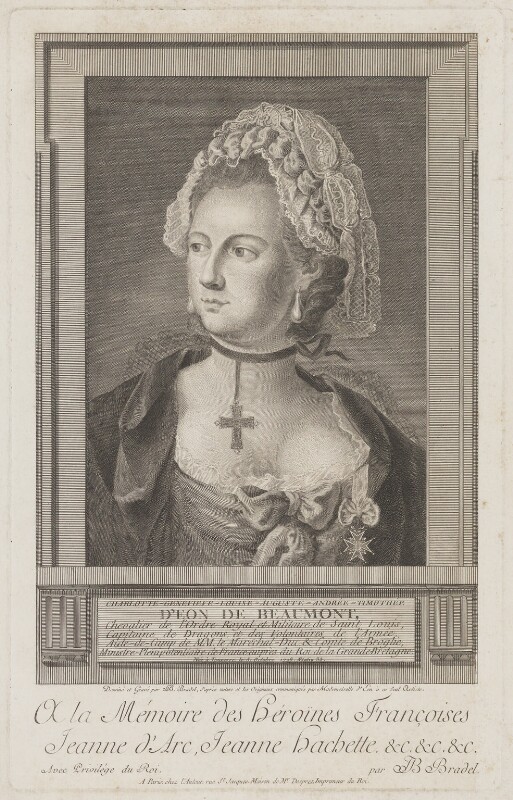
This podcast is an edited version of the talk “Fops, Fribbles and Female Husbands: Gender Diversity in Early America,” given at Historic London Town and Garden in Edgewater, Maryland, on February 15th, 2020. Join me on a tour of some of the fascinating and fantastic folks who could and did ‘break the rules,’ defining and expressing themselves in gender-non-conforming ways. Learn about William Cremer, Thomas/ine Hall, Mary Charles Hamilton, Deborah Sampson and the Chevalier d’Eon as we explore how gender-non-conformity was perceived as a threat to society but could also be presented in culturally acceptable and even celebrated ways.
A full transcript can be found at the end of this post.
Images: 1779 Engravings, courtesy of the National Portrait Gallery
Bibliography and Further Reading:
Baker, Sheridan. “Henry Fielding’s the Female Husband: Fact and Fiction.” PMLA 74, no. 3 (Jun 1959): 213-224. JSTOR.
Champagne, Roland A., Nina Ekstein and Gary Kates, Introduction to The Maiden of Tonnerre: The Vicissitudes of the Chevalier and the Chevaliere d’Eon. Baltimore: John Hopkins University Press, 2001.
Cleves, Rachel Hope. “’What, Another Female Husband?’: The Prehistory of Same-Sex Marriage in America.” Journal of American History 101, no. 4 (March 2015): 1055-1081. America: History and Life.
Friedli, Lynne. “Passing Women: A Study of Gender Boundaries in the Eighteenth Century.” In Sexual Underworlds of the Enlightenment, edited by George Sebastian Rousseau and Roy Porter. Chapel Hill: University of North Carolina Press, 1988.
Kates, Gary. Monsieur d’Eon is a Woman: A Tale of Political Intrigue and Sexual Masquerade. Baltimore: John Hopskins Press, 1995.
Reis, Elizabeth. “Hermaphrodites and ‘Same-Sex’ Sex in Early America.” In Long Before Stonewall: Histories of Same-Sex Sexuality in Early America, edited by Thomas Foster. New York: New York University Press, 2007.
Simon Burrows, Jonathan Conlin, Russell Goulborne and Valerie Mainz, ed. The Chevalier d’Eon and his Worlds: Gender, Espionage and Politics in the 18th Century. London: Continuum UK, 2010.
Young, Alfred. Masquerade: The Life and Times of Deborah Sampson, Continental Soldier. New York: Alfred A. Knopf, 2004.
Full Transcript:
The following is an edited version of the talk “Fops, Fribbles and Female Husbands: Gender Diversity in Early America,” given at Historic London Town and Garden in Edgewater, Maryland, on February 15th, 2020
[MUSIC]
It is October 22nd, 1827. John Quincy Adams is currently President of the United States of America. Andrew Jackson is going to win the presidential election next year, but they don’t know that yet. Travel by rail is picking up steam and Missouri has recently become the 24th state to be admitted to the United States. Next door, in Tennessee, a person is about to walk into a courtroom with an interesting petition.
[MUSIC ENDS]
By the time the court adjourns for the day, the general assembly of the state of Tennessee will enact the legal name change of one Susannah Cremer to the name William Cremer. They will rule that hereafter William Cremer will be bound by all contracts, obligations, bills, bonds and undertakings under that name and shall hereafter possess and exercise all the rights and privileges held and enjoyed by free male citizens of the state of Tennessee. In other words, the state assembly of Tennessee will enact one of the earliest successful legal gender changes in the United States.
We don’t know much about William Cremer. He was probably in his twenties when he made his way to the Tennessee courthouse. He had been considered a woman, worn feminine clothes and gone by the feminine name of Susannah for upwards of 20 years. In 1825, however, he moved to Virginia, dressed as a man, and married a wife before returning with her to Green county, Tennessee. We know that he lived and we know that he went against the gender norms of his time period. He wasn’t the first, nor of course, was he the last.
[MUSIC]
According to conduct and etiquette books from the turn of the 18th century, early Anglo-American society was strictly divided between two genders: male and female. Based on sexual difference, these two categories were supposedly immutable and dictated how a person ought to dress and behave. Men wore waistcoats, breeches, coats and tricorn hats. Women wore petticoats, gowns, jackets and caps. Oftentimes, our image of early America fits into these prescriptions. What I hope to do here for you today is highlight a few of the individuals who didn’t and convince you of gender-non-conformity’s deep historical roots.
[MUSIC ENDS]
A quick sidenote before we get too much further: As you may notice throughout this recording, I will not be using modern gender identities to refer these individuals. The purpose of my research is not to point at any of these individuals and prove them to be trans, non-binary or intersex, among any number of modern gender identities. They didn’t have our present day vocabulary with which to express their gender. Even when they were breaking the rules, these individuals had to work within the gender framework that was available to them. Modern vocabulary was not among that. Instead, my goal is to show how even if the vocabulary wasn’t there, the experiences were. So, as much as I won’t say “William Cremer was a trans man,” I will say that trans, non-binary and intersex experiences, like Cremer’s, have existed throughout history.
As such, I avoid a lot of modern terminology. I have a few exceptions, of course, to prove the rule. Both assigned female at birth and assigned male at birth are widely used by the modern trans community. An individual assigned female at birth is someone who has been perceived by society to be female, generally based on their anatomy, and thus is intended to follow feminine norms. An individual assigned male at birth is, by contrast, perceived to be male and intended to follow masculine norms. I use these terms for two reasons. Firstly, they are simply more concise than alternatives. Secondly, they do not take the individual’s gender for granted. Just as I do not wish to impose a queer gender identity on these individuals, I do not wish to impose a binary gender either. Thus, referring to William Cremer as assigned female at birth allows us to quickly understand what gender society intended him to express while also not encouraging us to assume that he was, in fact, a woman.
I also frequently will be using singular they/them pronouns. It’s difficult for historians to know exactly how people in the past felt about their genders. In a lot of cases, we don’t have a definitive action or statement from them about how they viewed themselves or their gender. Unless I have that, I will use they/them pronouns. Again, this is to avoid imposing a gender identity on them. ‘They’ avoids the implication that an individual’s expression was correct when it matched their assigned gender and was wrong or deceptive when it did not. It’s also convenient when an individual’s gender expression was fluid over the course of their life.
Now that that’s handled, let’s get to the fun stuff.
[MUSIC]
Gender troubles in the British American colonies started pretty much as soon as the colonists got here. Two centuries before William Cremer set foot in that Tennessee courthouse, in 1629, the General Court of colonial Virginia presided over a very different case.
[MUSIC ENDS]
Thomas/ine Hall had been brought before the court for dressing in women’s clothes. Hall, a maidservant recently employed by the planter John Atkins, was the center of a controversy that would become one of the earliest legal cases of ambiguous sex in colonial America. Deputies of the court, both male and female, would go on to examine Hall’s body multiple times in an attempt to fit Hall into one of two categories: man or woman. Scrutinized multiple times by different investigators, Hall’s body would not provide the Council an easy answer.
In the end, they ruled Hall’s biological sex ambiguous, ordering them to wear clothing representative of both genders. As recorded in the Court’s minutes, Hall was to wear “mans apparel, only his head to be attired in a Coyfe and Crosscloth with an Apron before him.” These last few garments were feminine ones.
More interesting than the Court’s decision, however, is Hall’s self-definition. At different times in their life prior to the court case, they presented as both a man and a woman. Assigned female at birth, they were raised as a girl named Thomasine. Later, they presented as a man – Thomas – to serve in the British military alongside their brother. After their service, Hall changed their gender expression again, presenting as a woman and supporting themself through the feminine career of making and selling lace. However, when they emigrated to the colonies as an indentured servant to Virginia, Hall presented once more as a man.
When asked during the trial, they defined themself as “both a man and a woeman.” Going back and forth between the gender binary, Hall went against the gender norms of their time, resulting in the legal case against them. What Hall’s story illuminates is that gender in early America did not fall within the strict confines of the gender binary that the General Court – and society, more generally – would wish to enforce.
But why was the General Court taking such an interest in Hall’s gender? The concern of the Court and Hall’s community was not simply their gender ambiguity, but the rumor that Hall had slept with a female servant. In this regard, Hall’s gender was of the utmost importance to determine if the alleged affair had been appropriate.
Controlling sexual behavior played a large role in the concern society had for gender and gender non-conformity. In cases of ambiguous gender, the court would try to determine and enforce a binary sex. Hall’s body and gender presentation upset that system. A century later, across the pond, Mary Charles Hamilton would face a less fortunate ruling.
Since the age of fourteen, Mary Hamilton (no relation to the famous protagonist of a certain Broadway musical) had dressed in men’s clothing and lived as a man. Born in Somerset, in England, Hamilton was assigned female at birth but left home at fourteen in their brother’s clothes. They moved across England to Northumberland where they apprenticed as a doctor before returning to Somerset as Dr. Charles Hamilton. In 1746, they courted Mary Price, the niece of the woman from whom they rented lodging. In July, Charles and Mary were married, but three months later, Charles found themself in court. Mary Price had had her new husband arrested under the charge of fraudulent marriage. Hamilton appeared in court still presenting as a man, reportedly ‘very gay, with Perriwig, Ruffles and Breeches.” Their gender presentation, as Hall’s had been, was insufficient for the court.
For the crime of fraud, Hamilton was sentenced to be publicly whipped and imprisoned for six months. Though it had been their gender non-conformity that had been at issue, importantly, Hamilton did not face punishment for dressing in men’s clothing. Their punishment was for marrying a woman and consummating the marriage, thereby compromising their own sexual virtue as well as that of another woman.
Sexual behavior, however, was not the only reason early American society was concerned with a clear cut gender binary. Gender was also tied to the proper functioning of society. The collapse of gender roles, in the eyes of the writers of gendered etiquette manuals, was the collapse of proper society and even the weakening of the empire. Ten years after Hamilton’s sensational trial, in 1757, author John Brown wrote: “The Sexes have now little other apparent Distinction […]: the one Sex having advanced into Boldness, as the other have sunk into Effeminacy.” Similarly, the Gentleman’s Magazine bemoaned, “[a] more unpleasant sight can scarcely be seen than that of a woman imitating the dress of [men].” In this correspondent’s opinion, this was “of worse consequence to the State.” Society running smoothly, they thought, required that the people who made it up fall into their proper role.
This became a greater concern as the British empire actually began to be tested.
[MUSIC]
The American Revolution and the many revolutions that followed it upturned many of the things people had taken for granted. What did it mean to be a British citizen? After independence, what did it mean to be an American citizen? Or a French citizen after the French Revolution? While people debated these questions in state halls, political clubs and salons, discussions also turned to gender. What did it mean to be a man? What did it mean to be a woman? Or for that matter: An American man? Or an American woman? In this identity struggle, people were paying more attention to gender and, in turn, gender was being more explicitly and rigidly defined.
[MUSIC ENDS]
As you might have caught on by now though, gender would not go quietly into those rigid categories.
Probably the most modernly well-known of the individuals I’ll mention today is Deborah Sampson. Sampson is just one story in which the turmoil of the American Revolution provided an opportunity to defy gender norms more so than it restrained them. Born in 1760 in Massachusetts and assigned female at birth, Deborah Sampson is most well-known for dressing as a man to join the Continental Army in 1782, at the age of twenty-two.
Sampson used a number of male identities over the course of their life and each represents a different moment of their non-conforming gender expression. In their first attempt to enlist, Sampson used the name Timothy Thayer, but never reported for duty. Sampson faced reprisals for the attempt but not of the formal legal kind. The Third Baptist Church of Middleborough accused them “of dressing in men’s clothes and in listing as a soldier.” Which was not, in their opinion, what a proper young lady was supposed to be doing. Sampson was thus excommunicated from the church. That didn’t stop them. The next time they tried, they had more success. As Robert Schurtliff, Sampson successfully joined the Continental Army and served as a light infantryman in the Fourth Massachusetts Regiment. They would go on to serve for a year and a half, participate in multiple skirmishes and be wounded at least twice. Their battle experience would include Tarrytown and New York.
In 1783, Sampson fell ill, not an uncommon occurrence for soldiers on either side of the conflict. Unfortunately for Sampson, during their illness, their biological sex was discovered. Woman were not permitted to fight in the army and, as an assigned female at birth individual, Sampson was, by that same token, not supposed to be fighting either. Sampson was honorably discharged and sent home. However, Sampson did not immediately return to the female role they were assigned at birth. Following their service, Sampson lived for a year in Massachusetts under the same Ephraim Sampson, Deborah’s younger brother, and worked as a farmer. Only after meeting Benjamin Gannett Jr, whom they married the following year, would Sampson return to a normative gender expression.
Under each of their male names, Sampson demonstrates how an assigned female at birth individual could express a masculine gender identity. The military provided solid employment and an outlet for patriotic zeal, but it also provided an opportunity for non-normative gender expression. Uniforms concealed the body and the military provided mobility and anonymity. The individual could leave the area where they were known by their assigned gender and start fresh with a new identity among strangers. This sort of mobility and fresh start might have been what William Cremer was looking for in the civilian world when he moved to Virginia in 1825.
The idea of a woman in man’s clothing was scandalous, but it could possibly be redeemed in the eyes of society. The difference in the outcomes between Cremer, Hamilton and Sampson’s stories show just that. If the assigned female at birth person was ruled to be male, as was the case for Cremer, the premise of punishment disappeared. A man, after all, could not be punished for wearing men’s clothing and performing a male role. If an assigned female at birth individual was ruled to be female, as with Hamilton and Sampson, the next question was their virtue. As we’ve seen with Hamilton, sexual virtue played a large role.
The key for Sampson was the timing. Sampson had been discovered after proving their worth in combat and after the Continental Army had won their victory. Instead of being interrogated for subverting gender norms, Sampson was celebrated for their dedication and contribution to the patriot cause. Despite what should have been rigid categories, gender was malleable, allowing people to flaunt the rules and even get away with it, as it were, depending on the circumstances.
These themes of virtue and patriotism can be found in many other cases of gender-non-conformity in the early Atlantic world, including the high profile case of a French noble by the name of the Chevalier d’Eon. Well, actually, as a French noble, their name was much more complicated: Charles-Geneviève-Louis-Auguste-André-Timothée d’Éon de Beaumont. But I’ll be using Chevalier d’Eon, because that’s a mouthful.
[MUSIC]
In 1777, the Chevalier, or should I say, the Chevaliere, would become the talk of both the French and British empires.
[MUSIC ENDS]
Assigned male at birth, the Chevalier d’Eon lived for the first fifty ears of her life as a man. Born in Burgundy, in east-central France, to a lower ranking noble family, d’Eon entered the French political scene in the court of Louis XV. The 1750s in Western Europe were a tumultuous time and d’Eon found herself caught right in the middle of it. Her impressive political career began in secret, working as a spy for the Secret du Roi, or The King’s Secret, Louis XV’s personal secret body of spies who worked independently of the French foreign ministry. As a spy, d’Eon was dispatched to Russia in order to strengthen the relationship between the French king and the Russian Empress, Elizabeth. An alliance between the two empires, and that of Habsburg Austria, would become invaluable when war erupted in 1756. While the French government offered Empress Elizabeth military subsidies, d’Eon became part of her court, facilitating the two rulers’ secret correspondence and influencing Russian nobles with her charms and, reportedly, over 3,000 livres of French wine that she had sent to her over the course of her stay in Russia. As the Seven Years’ War – the European side of the French and Indian War, as we tend to call it here in the United States – drew on, d’Eon returned to France, her secret mission a success, and served as a dragoon captain in the French military.
For her diplomatic and military service, d’Eon, at the young age of 35, was awarded the Cross of Saint-Louis. This prestigious medal was awarded to noble military officers for acts of unusual heroism and bravery in war. Thus, d’Eon received the rank of Chevalier, or Knight. The war was less rewarding for France itself. In the peace treaty with Britain in 1763, France lost its colonial holdings on the North American continent.
But what does all of this have to do with gender?
After the war, d’Eon moved to London, continuing to work as a spy. In 1770, a peculiar rumor began to circulate.
[MUSIC]
Word had it that the Chevalier d’Eon was, in fact, a woman. We don’t know where the rumor started or why, but once it began, it quickly grew. Londoners started betting on d’Eon’s, quote, “true gender.” D’Eon emphatically fended off bribes for ‘proof’ and took great insult at the suggestion, even challenging people to duels. Whether purposeful or not, d’Eon’s reaction only served to stoke the public’s fascination. Was the famed Chevalier of military and diplomatic distinction secretly a woman in disguise? The subject quickly become a favorite for the gambling sort. Hundreds of thousands of pounds were wagered on the question and individual bets came before the British court three times in 1777.
No one could agree, but evidence stacked in favor of d’Eon being a woman. The French court dispatched a secretary to discover the truth in 1772; the man reported back to France that d’Eon was “nothing other than a girl.” To settle the gambling debts, the British court summoned witnesses who reported that d’Eon was, in fact, biologically female. Among others, one of d’Eon’s former physicians swore “certain knowledge” of d’Eon’s womanhood. The British court ruled that d’Eon was a woman and the bets were settled accordingly. Both the courts of France and Britain were convinced that d’Eon was biologically female.
[MUSIC ENDS]
In 1777, when she returned to the court of Louis XVI, she did so dress in women’s clothing. D’Eon declared herself to be a woman and would go on to live the rest of her life, the next 33 years, as a woman. Rewriting the story of her life thusfar, d’Eon announced that she had in fact been assigned female at birth, but that it had been kept secret so that her parents could raise her as a boy. She had thus kept her sex a secret in order to have a political and military career.
In her own words, she told the story of her time as a spy in Russia. Not only was d’Eon at the Russian court as a male ambassadorial secretary, she also infiltrated it as a female tutor and confidante to Empress Elizabeth herself. She told the story of leaving France with two trunks, one with men’s clothes and the other with women’s clothes. Due to her secret, she said, she was perfectly positioned to play the role.
There is little to corroborate d’Eon’s story about her time in Russia. What we do know is that from 1777 onwards, she lived as a woman, still proudly bearing her military award for bravery. Retaining her title of Chevalier, she participated in fencing matches against men. People continued to be fascinated by her gender, but, as with Cremer being found male, if d’Eon was in fact assigned female at birth, there was nothing odd about her dressing in woman’s clothing. Rather, it was her time presenting as a man that made her exceptional during her time period. D’Eon defended her time as a man in the same way Sampson and others before had: she had done it to serve king and country and had remained virtuous. Therefore, she could be celebrated as an exceptional woman who went above and beyond for France.
The fascination did not stop, even at d’Eon’s death. In May 1810, d’Eon passed away at the age of 82. Just as Hall’s body had been examined two centuries prior, the Chevalier’s was examined after her death. The autopsy reported that she was, in fact, assigned male at birth. Though that seemed to close the matter for her contemporaries, it hardly tarnishes the way she defied the gender norms of her time. Her body did not define her and as such, she expressed her gender the way she saw fit.
Fifteen years later, William Cremer would do something similar when he moved from Tennessee to Virginia. Maybe he had heard of the Chevalier. Her story had made its way across the Atlantic, her memoirs sold in shops in Philadelphia and her story inspiring multiple satirical works and characters in plays. It’s entirely likely that he hadn’t. We will never know. Either way, Cremer followed in a long line of people who, for whatever their reasons, expressed their genders in ways that defied the norms of their time period. Gender was hardly as immutable as early American society would have liked to have claimed and stories of gender non-conformity were fascinating, more so than horrifying, to the general public. Hopefully, by sharing some of their stories with you here today, I have shown you all that gender and gender expression in early America and the early Atlantic world was much more diverse than we might otherwise give it credit for.
[MUSIC OUTRO]
This podcast has been written and recorded by Caitlin Hartweave. Music for this podcast includes ‘Wishful Thinking’ and ‘Bring Me Your Sorrows’ by Dan Lebovitz as well as ‘Lord of the Land” and ‘Call to Adventure – Comedy’ by Kevin McLoid. Thanks for listening. See you next time.
[MUSIC FADES]